Guelph’s used car market has grown rapidly over the past decade. With rising new vehicle prices, long factory wait times, and higher interest rates, more buyers than ever are turning to pre-owned vehicles as a practical, cost-effective solution. Whether you are a first-time buyer, a student at the University of Guelph, a commuter to the GTA, or a family looking for value, understanding how the used car market works in Guelph can save you thousands of dollars and prevent costly mistakes.
This guide breaks down everything you need to know about buying used cars in Guelph, including market trends, pricing, where to buy, inspections, financing, and ownership costs.
Why Used Cars Are in High Demand in Guelph
Several factors drive Guelph’s strong used vehicle demand:
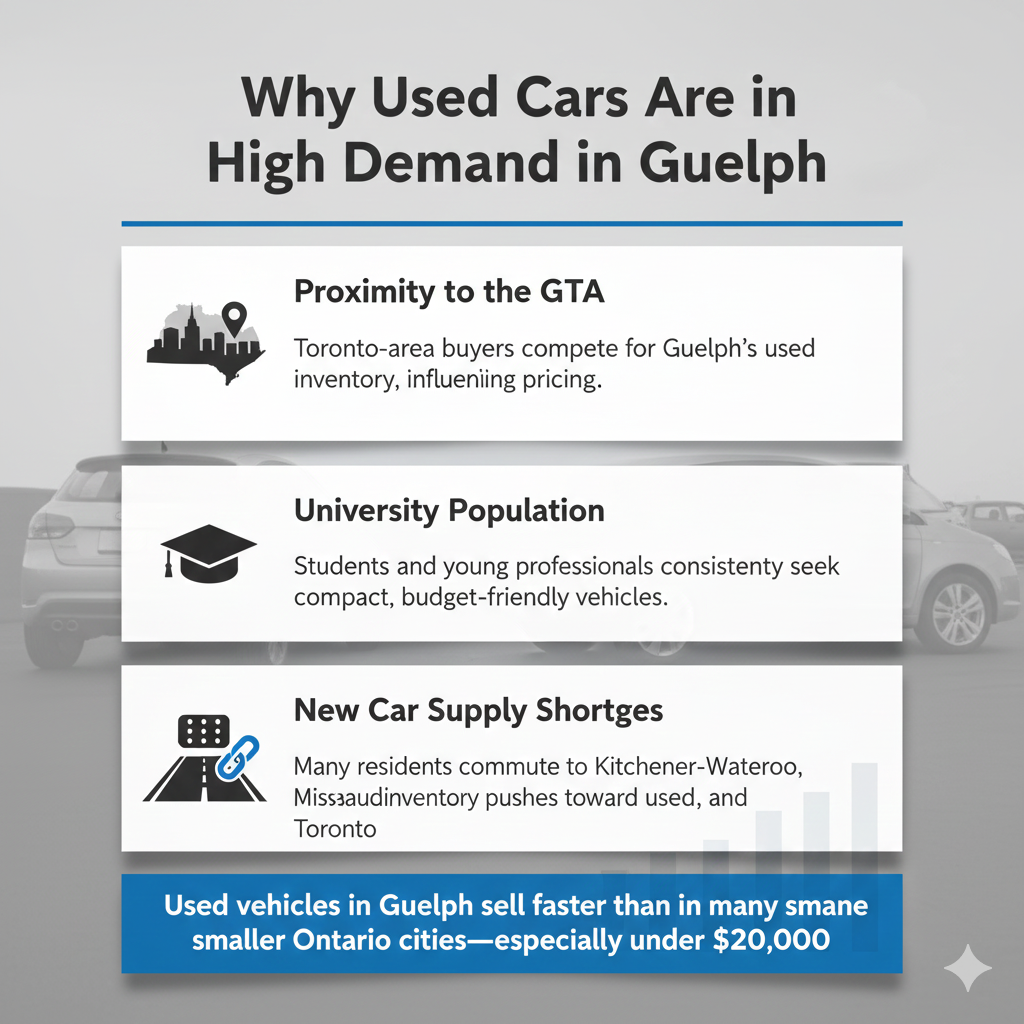
- Proximity to the GTA: Many buyers compete with Toronto-area shoppers, which impacts pricing.
- University population: Students and young professionals create consistent demand for compact and budget-friendly vehicles.
- Commuter traffic: Guelph residents frequently commute to Kitchener-Waterloo, Mississauga, and Toronto.
- New car supply shortages: Limited new vehicle inventory continues to push buyers into the used market.
As a result, used vehicles in Guelph typically sell faster than in many smaller Ontario cities, particularly in the sub-$20,000 segment.
Average Used Car Prices in Guelph (2024–2025)
While pricing changes monthly, current average ranges in Guelph look like this:
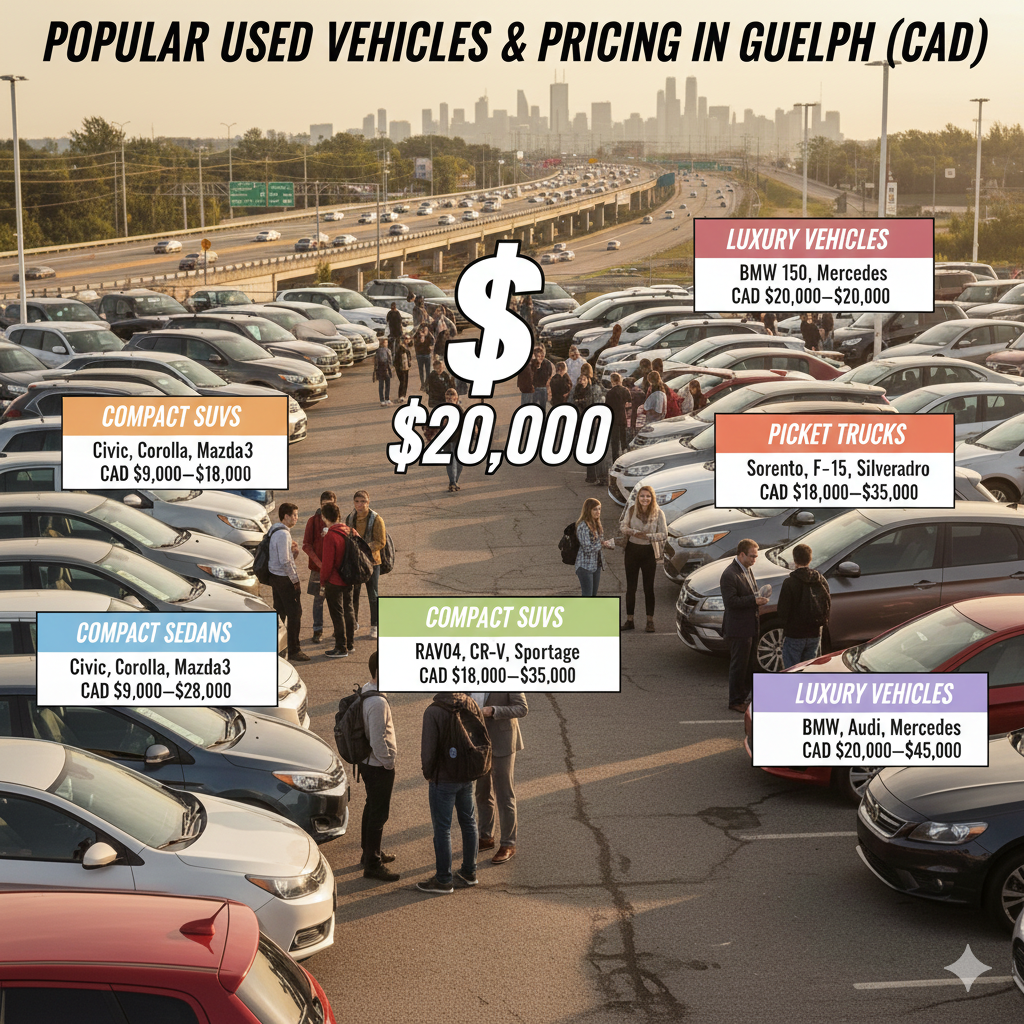
- Compact sedans (Civic, Corolla, Mazda3): CAD $9,000–$18,000
- Compact SUVs (RAV4, CR-V, Sportage): CAD $14,000–$28,000
- Mid-size SUVs (Sorento, Highlander, Edge): CAD $18,000–$35,000
- Pickup trucks (Ram 1500, F-150, Silverado): CAD $20,000–$45,000
- Luxury vehicles (BMW, Audi, Mercedes): CAD $22,000–$50,000
Prices vary heavily based on mileage, service history, accident history, and ownership records. Vehicles with clean Carfax reports and single ownership tend to command a significant premium.
Where to Buy Used Cars in Guelph
Buyers in Guelph generally choose from three main purchasing channels:
1. Franchised Dealerships
These dealerships sell both certified and non-certified used vehicles. Benefits include:
- Full safety inspection
- Vehicle history reports
- Limited warranties or certified programs
- Financing options
Pricing is higher than private sales but offers better legal protection and financing access.
2. Independent Used Car Lots
These lots often carry higher-mileage vehicles and budget-oriented inventory. Buyers can find lower upfront pricing but should be cautious with inspections and warranty coverage.
3. Private Sellers
Marketplace, Kijiji, and community boards offer private listings. These may provide the lowest prices but also carry the highest risk. No warranties, no returns, and limited legal protection apply.
What to Look for When Buying a Used Car in Guelph
Vehicle History Report
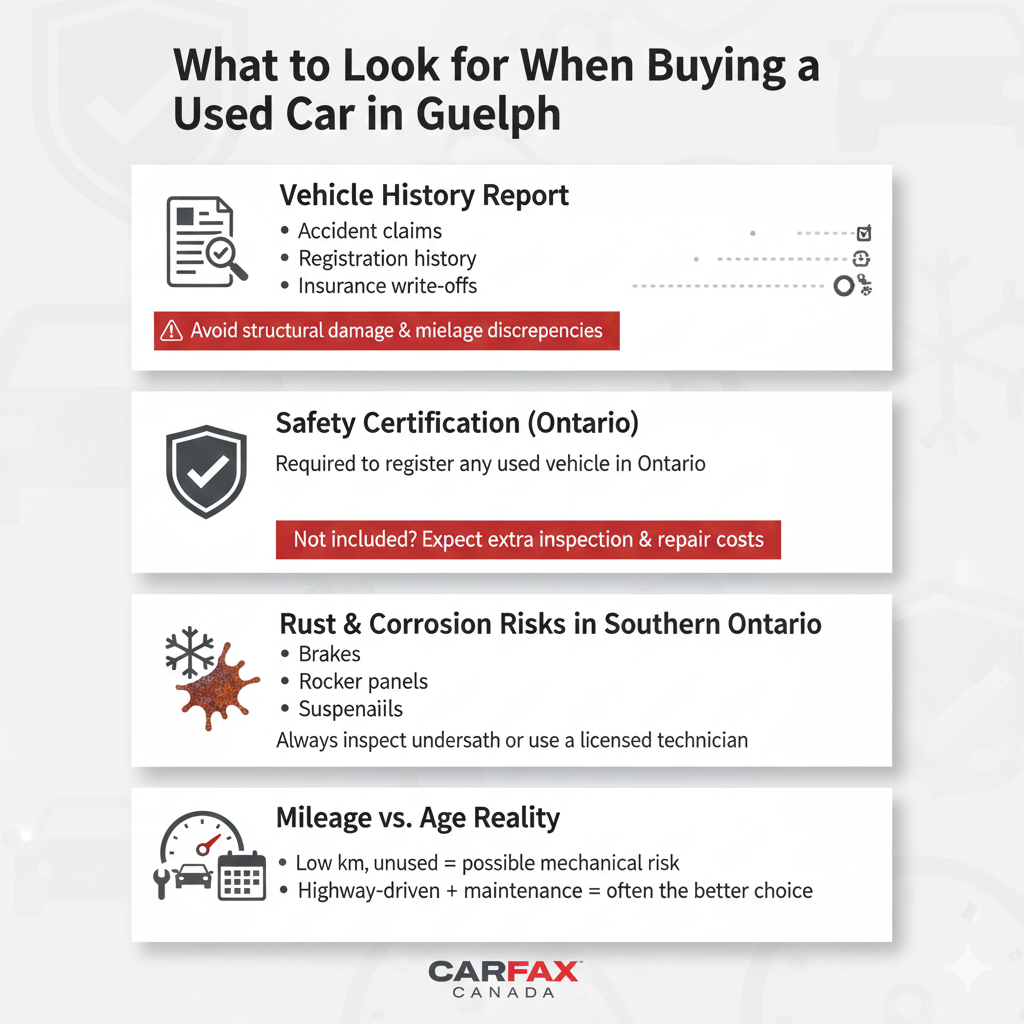
Always request a Carfax Canada report. It reveals:
- Accident claims
- Registration history
- Odometer readings
- Insurance write-offs
Avoid vehicles with structural damage or unexplained mileage discrepancies.
Safety Certification
In Ontario, a used vehicle cannot be registered without a safety certificate. Make sure this is included in your deal or be prepared to pay for the inspection and repairs separately.
Rust and Corrosion
Southern Ontario winters accelerate rust, particularly on:
- Brakes
- Rocker panels
- Frame rails
- Suspension components
Always inspect under the vehicle or have a licensed technician do it.
Mileage vs. Age
A lower-kilometre vehicle is not always better. A 10-year-old vehicle with 60,000 km that sat unused may develop mechanical issues faster than a highway-driven vehicle with higher mileage but strong maintenance records.
Financing Used Cars in Guelph
Used car financing is widely available through banks, credit unions, and dealership partners. Typical loan terms include:
- Interest rates: 7.99%–13.99% depending on credit
- Loan length: 36–72 months
- Minimum income verification required
Shorter loan terms result in lower interest paid overall, even if monthly costs are slightly higher.
Buyers with limited credit history may benefit from:
Insurance Costs in Guelph
- Co-signers
- Larger down payments
- Pre-approval through personal banks before shopping
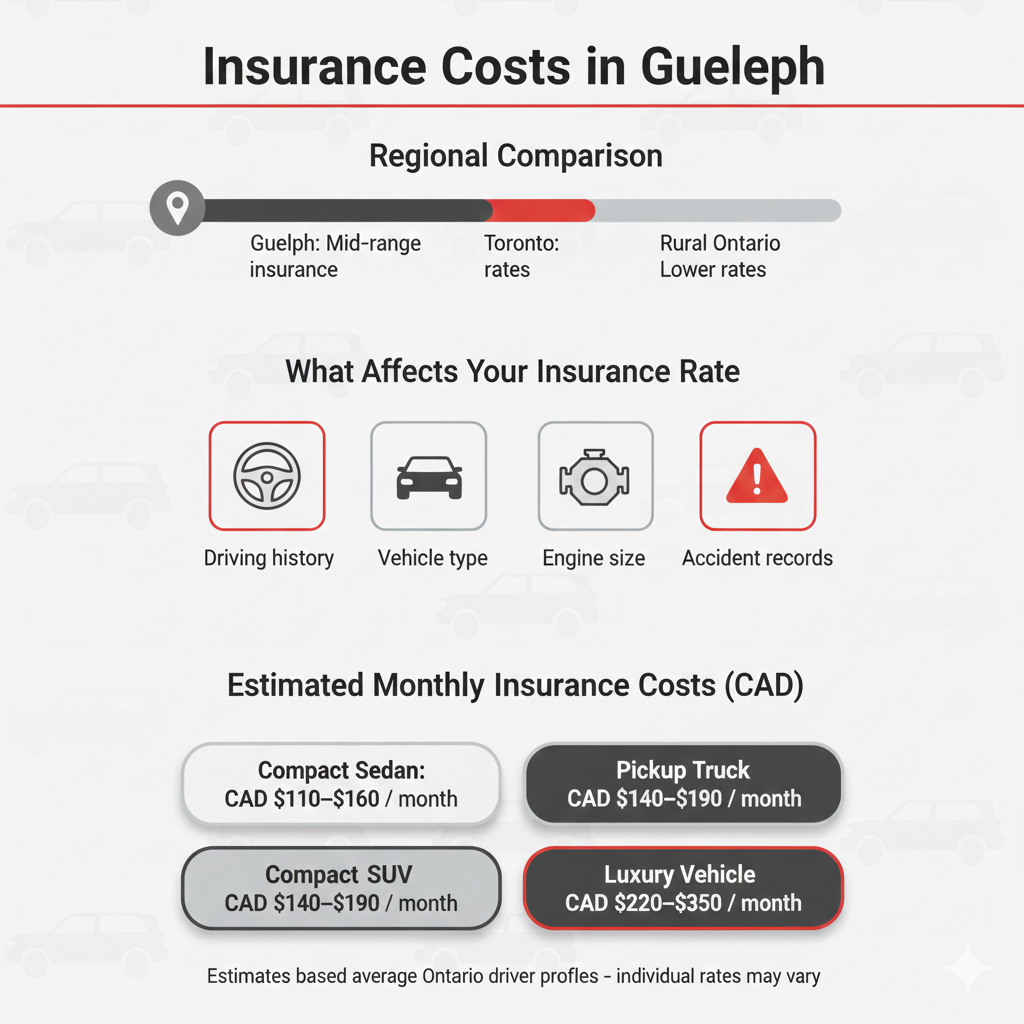
Insurance rates in Guelph are lower than Toronto but higher than many rural cities. Factors affecting insurance include:
- Driving history
- Vehicle type
- Engine size
- Accident records
Estimated monthly insurance ranges:
- Compact sedan: CAD $110–$160/month
- Compact SUV: CAD $140–$190/month
- Pickup truck: CAD $160–$240/month
- Luxury vehicle: CAD $220–$350/month
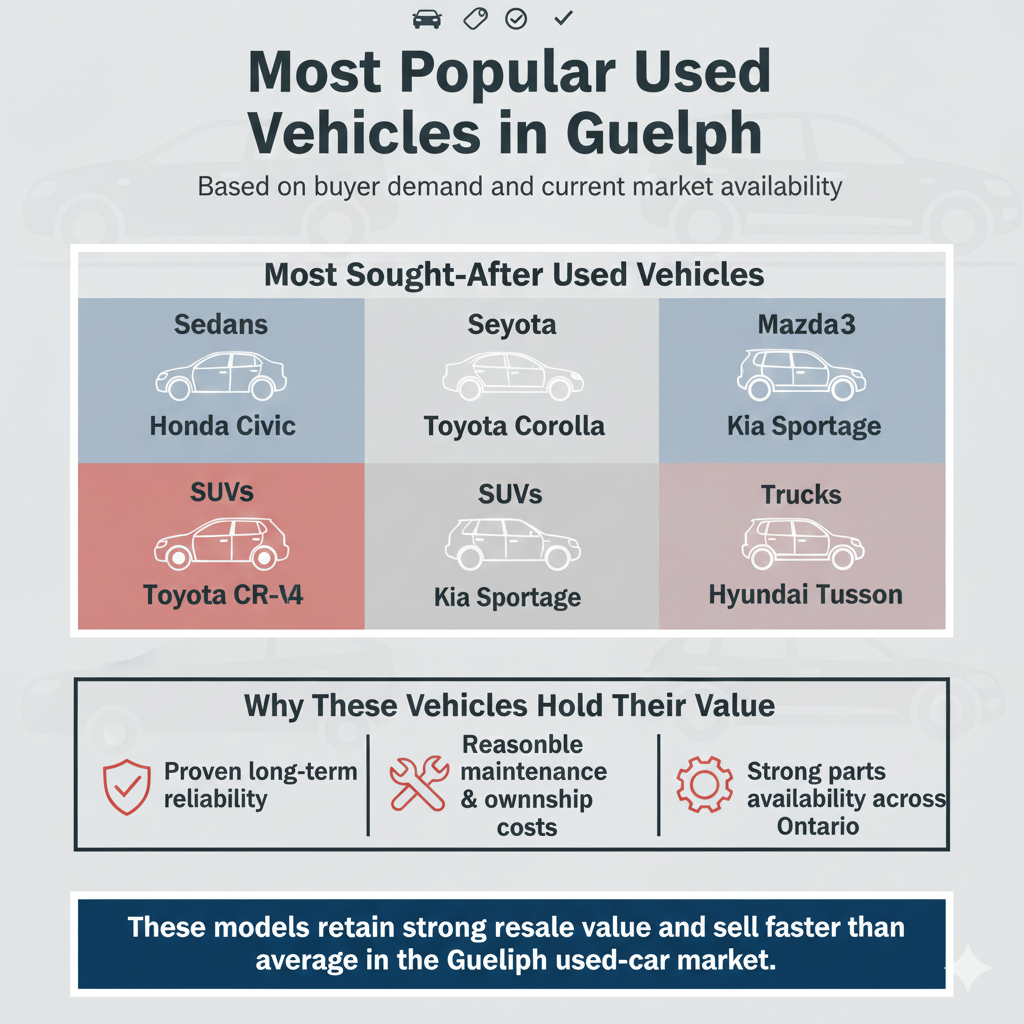
Most Popular Used Vehicles in Guelph
Based on buyer demand and availability, the most sought-after used vehicles include:
- Honda Civic
- Toyota Corolla
- Mazda3
- Toyota RAV4
- Honda CR-V
- Kia Sportage
- Hyundai Tucson
- Ram 1500
- Ford F-150
These vehicles hold value well due to reliability, reasonable ownership costs, and strong parts availability.
Ownership Costs to Consider
Many buyers focus only on the purchase price, but ownership costs add thousands over time:
- Fuel: CAD $2,000–$3,500 annually depending on driving habits
- Maintenance: CAD $800–$1,500 annually
- Repairs: CAD $500–$2,000 annually (varies by model)
- Registration and licensing: CAD $120–$240 annually
- Tires: CAD $800–$1,600 every 4–6 years
Reliable vehicles with strong service records consistently cost far less to own than older luxury vehicles.
Certified Pre-Owned vs Regular Used Vehicles
Certified Pre-Owned (CPO) vehicles typically include:
- Expanded warranty coverage
- 100+ point mechanical inspections
- Roadside assistance
- Exchange privileges
They cost more upfront but reduce long-term mechanical and safety risks. Non-certified used vehicles may be cheaper but often include no warranty at all.
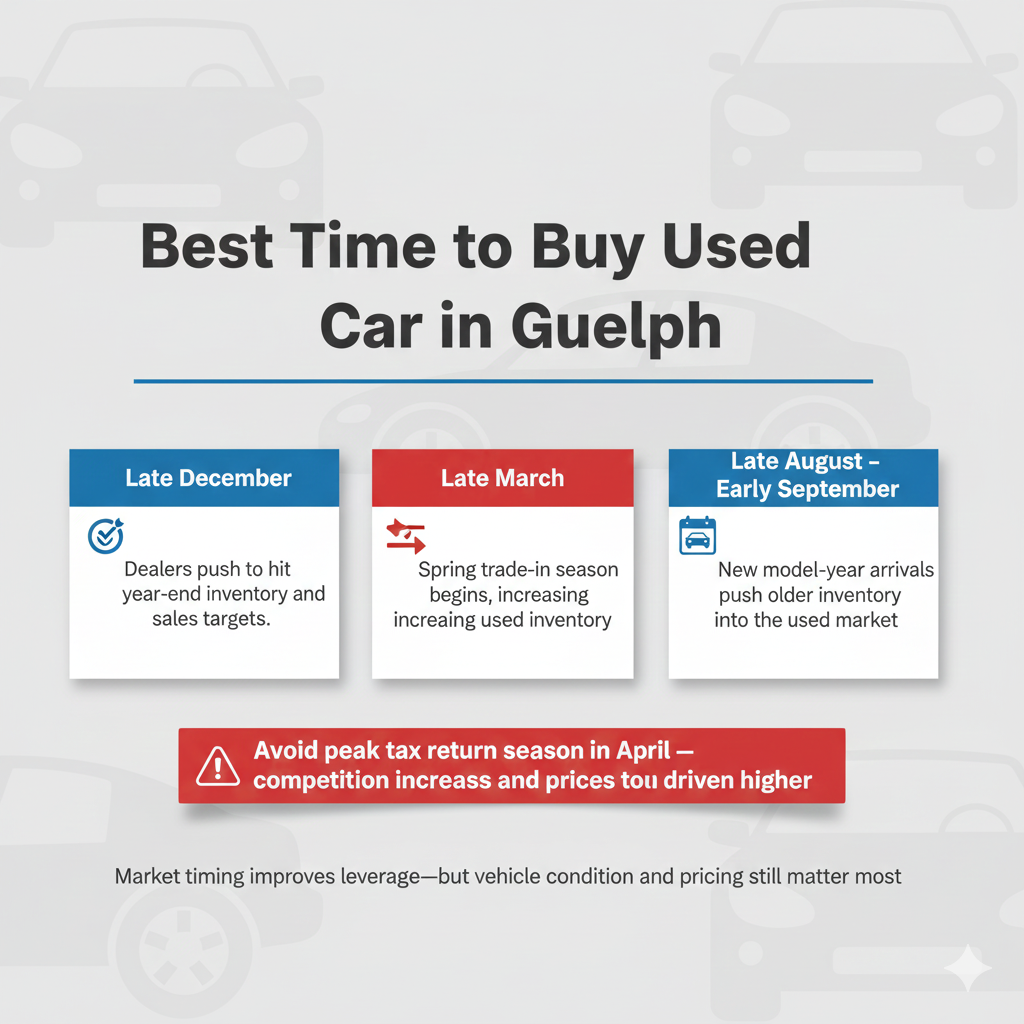
When Is the Best Time to Buy in Guelph?
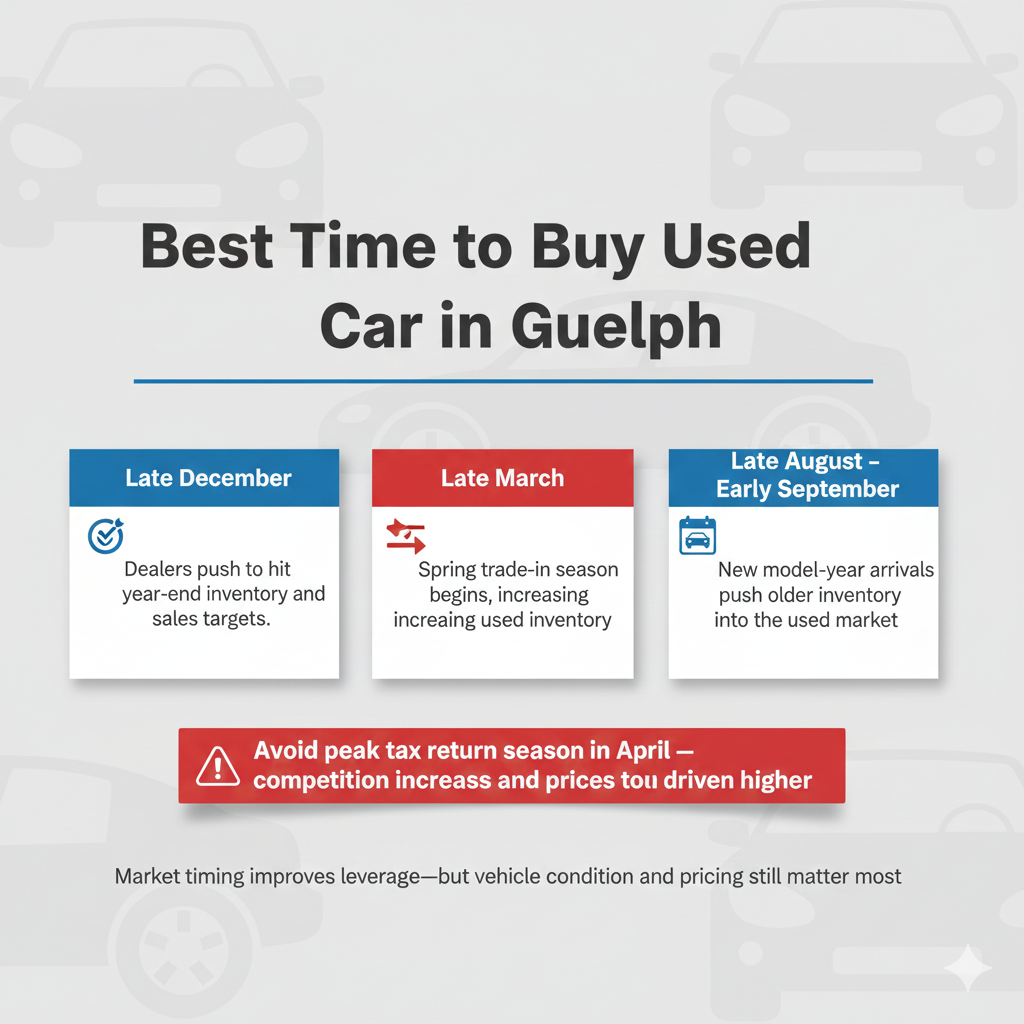
Historically, the best buying periods include:
- Late December: Dealer inventory targets
- Late March: Trade-in season begins
- Late August to early September: New model-year arrivals
Avoid peak tax return season in April when competition pushes prices higher.
Common Mistakes Buyers Make
- Skipping third-party inspections
- Buying based on low price alone
- Ignoring insurance costs
- Overextending loan terms
- Failing to review maintenance history
Used car mistakes usually show up six to twelve months after purchase, often as unexpected mechanical failures.
How to Negotiate Used Car Prices in Guelph
Negotiation is still a critical part of buying a used vehicle in Guelph, even in a competitive market. While prices are more transparent than ever due to online listings, most used vehicles still have some room for negotiation depending on demand and condition.
Effective negotiation strategies include:
- Research comparable listings in Guelph, Kitchener, Waterloo, and Milton before visiting a dealership.
- Identify leverage points, such as vehicle age, tire condition, upcoming maintenance, or cosmetic damage.
- Avoid negotiating solely on monthly payment—focus on total vehicle price.
- Be ready to walk away, especially if inspection concerns arise.
Private sellers generally have more flexibility on price, while dealerships are more likely to negotiate on fees, warranties, or trade-in values rather than headline price.
Understanding Ontario Taxes and Fees on Used Cars
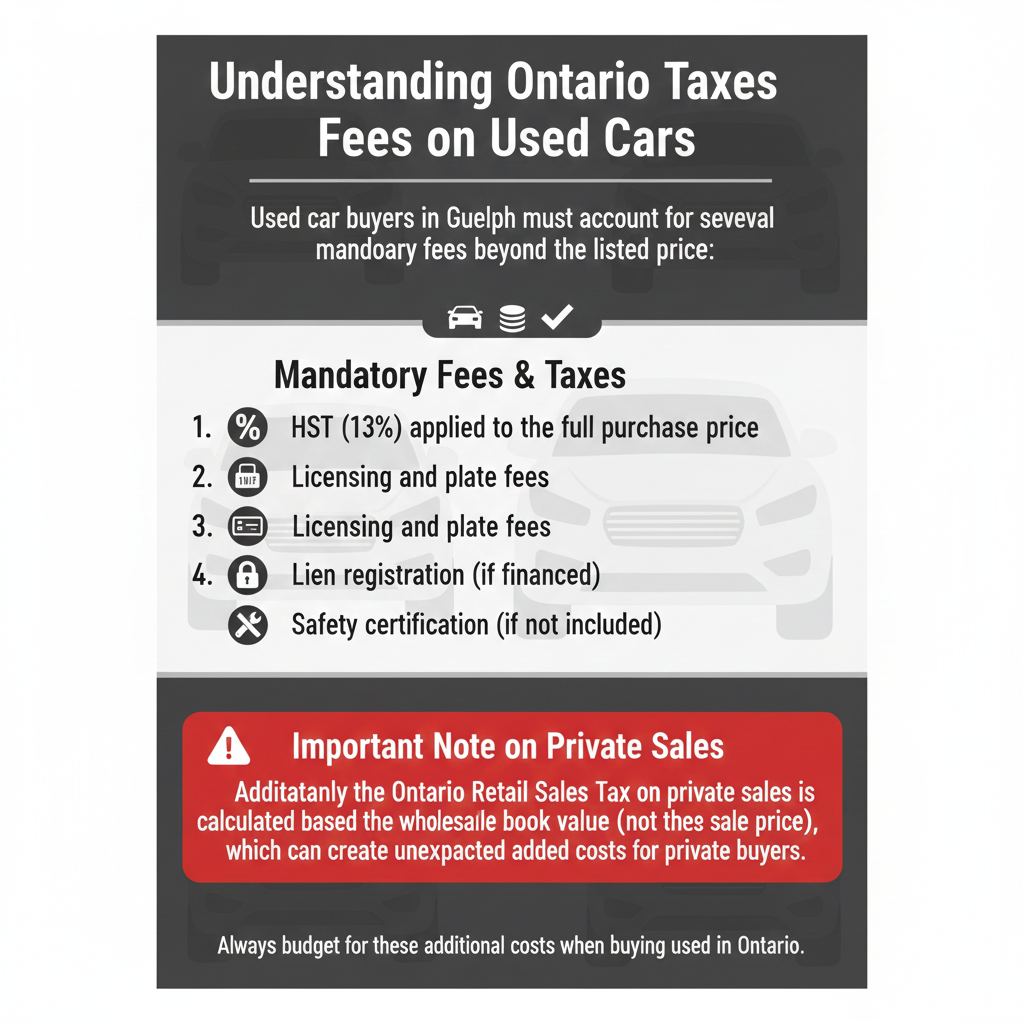
Used car buyers in Guelph must account for several mandatory fees beyond the listed price:
- HST (13%) applied to the full purchase price
- Licensing and plate fees
- Lien registration (if financed)
- Safety certification (if not included)
Additionally, the Ontario Retail Sales Tax on private sales is calculated based on the vehicle’s wholesale book value (not the sale price), which can create unexpected added costs for private buyers.
Trade-Ins and Their Impact on Used Car Deals
Many buyers in Guelph use trade-ins to help reduce their used vehicle purchase price. Trade-in values depend on:
- Vehicle age and mileage
- Accident history
- Mechanical condition
- Market demand
Trading in at a dealership reduces HST payable on the replacement vehicle, which can save hundreds or even thousands of dollars. However, private sales usually yield higher cash value but require more time and effort.
Student Buyers in Guelph: What to Know
Students from the University of Guelph represent a major segment of local used car buyers. Key considerations for student buyers include:
- Budget limits and monthly affordability
- Insurance classifications for young drivers
- Fuel efficiency for commuting
- Winter driving capability
Student buyers commonly focus on compact sedans, hatchbacks, and small SUVs with strong fuel economy and affordable parts.
Winter Readiness and Seasonal Buying Considerations
Southern Ontario winters place unique stress on used vehicles:
- Battery performance drops significantly
- Suspension and steering wear accelerates
- Rust exposure increases
- Tire quality becomes critical for safety
Winter-ready used vehicles in Guelph should ideally include winter tires, recent battery replacement, functioning heating systems, and rust protection. Buyers shopping in fall and winter should factor seasonal maintenance into pricing.
Should You Buy Extended Warranties on Used Cars?
Extended warranties can offer peace of mind but should be evaluated carefully. Coverage varies widely based on:
- Mileage limits
- Duration (2–5 years)
- Coverage scope (powertrain vs comprehensive)
Most extended warranties range from CAD $1,200 to $4,500. They are most worthwhile on vehicles with:
- Turbocharged engines
- Luxury electronics
- Complex transmissions
Reliable economy vehicles with proven track records often cost less to repair than the price of extended warranty coverage.
Electric and Hybrid Used Vehicles in Guelph
Used EV and hybrid availability in Guelph continues to rise. Buyers considering electric or hybrid vehicles should verify:
- Battery health status
- Charging compatibility at home
- Warranty status on battery systems
- Cold-weather range impacts
While used EV prices have dropped rapidly, repair costs and long-term battery replacement expenses must be carefully evaluated.
Environmental and Fuel Efficiency Trends
With rising fuel costs, fuel efficiency remains a top decision factor for Guelph buyers. Typical fuel economy averages:
- Compact sedan: 6–7 L/100 km
- Compact SUV: 8–9 L/100 km
- Mid-size SUV: 9–11 L/100 km
- Pickup truck: 11–15 L/100 km
Even small efficiency differences can translate to thousands of dollars in fuel savings over ownership.
Real Vehicle Lifespan Expectations in Ontario
Modern vehicles routinely exceed 250,000 km when properly maintained. Common lifespan estimates:
- Japanese compact cars: 300,000+ km
- Domestic pickup trucks: 250,000–350,000 km
- Luxury brands: 200,000–280,000 km
Service records matter more than brand reputation alone.
Maintenance Records and Their True Importance
A vehicle’s service history is one of the strongest predictors of long-term reliability. Two vehicles with identical mileage and age can have drastically different ownership outcomes depending on maintenance quality. Buyers should prioritize vehicles with:
- Regular oil changes documented
- Transmission services completed on schedule
- Brake service history available
- Cooling system inspections recorded
- Timing belt or chain service confirmed (where applicable)
Gaps in maintenance records do not automatically disqualify a vehicle, but they dramatically increase financial risk. Vehicles with full service documentation consistently outperform similar models without records over long-term ownership.
Used Vehicle Inspections: What a Proper Inspection Should Include
A professional pre-purchase inspection is one of the smartest investments a used car buyer can make. In Guelph, licensed inspections typically cost CAD $120–$200 and should include:
- Engine compression testing (where applicable)
- Transmission shifting behavior
- Brake thickness and rotor condition
- Suspension and steering component wear
- Exhaust system and emissions performance
- Frame and structural integrity
- Undercarriage rust assessment
- Fluid leaks and seepage
- Electrical system and warning light diagnostics
Buyers who skip inspections often end up spending several times that cost in repairs within the first year of ownership.
Rebuilt Titles and Accident Vehicles in Guelph
Some used vehicles in the Guelph market carry rebuilt or branded titles, meaning they were previously declared total losses by insurers and later repaired. These vehicles are generally priced lower but carry significant risks:
- Reduced long-term reliability
- Limited resale value
- More complicated insurance approval
- Potential hidden frame damage
Vehicles with minor accident claims are common, but buyers should avoid vehicles that involved structural damage, airbag deployment, or flood damage.
Vehicle Recalls and Safety Compliance
Before purchasing any used vehicle, buyers should check for active recalls using the manufacturer’s VIN lookup tool. Safety-critical recall repairs are usually free at franchised dealerships, but unresolved recalls can:
- Delay vehicle registration
- Create insurance complications
- Cause safety hazards
Recalls commonly affect airbags, braking systems, electronic stability control, and fuel system components.
Ownership Costs Beyond the First Year
Many buyers budget for purchase and insurance but underestimate second- and third-year ownership costs. These often include:
- Full brake replacements
- Suspension wear repairs
- Major fluid services
- Battery replacements
- Tire replacements
A typical used vehicle may require CAD $2,000–$4,000 in ownership expenses within the first 24 months depending on age and mileage.
Reliability vs Brand Perception
Brand reputation alone is not a reliable measure of ownership cost. While some brands historically score higher in reliability studies, condition matters more than badge. A well-maintained vehicle from a mid-tier brand nearly always outperforms a neglected vehicle from a premium brand over time.
Buyers should look at:
- Powertrain design complexity
- Turbocharging and hybrid system complexity
- Parts availability
- Technician familiarity in local repair shops
These practical factors heavily influence ownership satisfaction in Guelph.
Family Buyers and Vehicle Safety Priorities
For families, safety and space often outweigh fuel economy or styling. Features that matter most include:
- Advanced driver assistance systems (ADAS)
- Rear occupant protection ratings
- Stability control performance
- Child seat anchor accessibility
- Real-world braking performance in winter conditions
Mid-size SUVs and minivans remain the most practical choices for growing families due to interior space, crash protection, and winter traction stability.
Commercial and Work Vehicle Buyers in Guelph
Contractors, tradespeople, and delivery drivers represent another major used vehicle segment. Their priorities include:
- Payload and towing capacity
- Durability under daily load stress
- Parts accessibility
- Downtime minimization
Pickups and cargo vans dominate this space, but buyers should pay close attention to drivetrain wear and suspension condition under previous commercial use.
Vehicle Depreciation and Resale Timing
Used vehicles depreciate more slowly than new vehicles, but value still decreases each year. Key resale timing observations include:
- The steepest depreciation occurs in the first 3–5 years
- Vehicles held after seven years depreciate more slowly
- High-mileage threshold drops resale rapidly around 180,000–200,000 km
Buyers planning short-term ownership should prioritize resale stability more than purchase discount.
Financing Risk and Equity Management
Used car buyers often face higher interest rates than new car buyers. Managing loan equity correctly prevents financial traps such as:
- Owing more than vehicle value (negative equity)
- Overextending loan terms beyond vehicle lifespan
- Rolling previous debt into new purchases
Down payments of 15–25% significantly reduce long-term financial strain and improve resale flexibility.
Understanding Market Fluctuations in Guelph’s Used Car Industry
Like the broader Ontario market, Guelph’s used car prices fluctuate based on seasonality, supply chain conditions, fuel trends, and economic pressures. Several recurring patterns influence pricing:
- Spring demand increases: As weather improves, more buyers enter the market, raising competition and slightly increasing prices.
- Fall and winter softening: Harsh weather and holiday spending reduce buyer activity, creating occasional opportunities for price negotiation.
- Fuel price spikes: Whenever fuel costs rise, efficient compact cars and hybrids see increased demand, widening their price gap relative to less efficient models.
- Manufacturing delays: Any slowdown in new vehicle production—whether due to chip shortages or logistical issues—pushes more shoppers toward the used market.
Consumers who understand these patterns are better equipped to time their purchase strategically for maximum value.
Evaluating Total Cost of Ownership (TCO)
A low purchase price does not guarantee long-term savings. Total Cost of Ownership (TCO) is a far more accurate predictor of affordability. TCO includes:
- Purchase price
- Fuel costs
- Maintenance and repair expenses
- Depreciation
- Insurance premiums
- Financing interest
For example, a used luxury sedan with a seemingly attractive purchase price may still cost more annually due to higher insurance, expensive parts, and premium tire sizes. Conversely, a well-maintained compact car may cost significantly less over five years despite a modestly higher selling price.
Buyers in Guelph should evaluate long-term costs, not just monthly payments or sticker price.
The Role of Depreciation in the Used Market
Depreciation levels depend on segment and brand:
- Economy vehicles: Slow, predictable depreciation after year five.
- Hybrid and electric models: Volatile depreciation depending on battery condition and incentives.
- Luxury brands: Fastest depreciation due to expensive repairs and tech obsolescence.
- Pickup trucks: Historically strong resale, especially in Ontario.
Vehicle depreciation becomes more stable after the first major drop (years 1–3), making vehicles aged 4–7 years a sweet spot for value-conscious buyers.
Evaluating Vehicle Fit for Local Driving Needs
Guelph includes a mix of urban, rural, and highway driving, which affects which vehicles perform best:
- Urban Driving (Downtown Guelph): Compact cars with tight turning radius and good fuel economy.
- University of Guelph Roads: Reliable, low-maintenance hatchbacks and small SUVs that handle winter conditions well.
- Highway 7, 401, and Commuter Traffic: Mid-size SUVs or sedans with better acceleration, stability, and noise insulation.
- Rural Surroundings (Eramosa, Puslinch): Crossovers or trucks with all-wheel drive and stronger suspension.
Matching the vehicle to your actual daily driving environment improves safety and minimizes long-term wear.
How Supply Chain Issues Still Influence Used Car Prices
Although global supply chain disruptions have improved, several lingering effects remain:
- Many 2021–2022 vehicles had lower production volumes, reducing the number of lightly used models available today.
- Rental car companies continue to hold onto fleets longer, reducing the flow of used inventory into the market.
- Some manufacturers experienced extended disruptions, leading to scarcity in specific models, trim levels, and powertrains.
These factors create unusual pricing structures where certain older models may be priced similarly to newer ones due to inventory shortages.
The Importance of Test-Driving in Multiple Conditions
A thorough test drive reveals more than online listings ever can. Buyers should:
- Test the vehicle on city streets, open roads, and rougher surfaces.
- Listen for suspension noises, wind noise, and drivetrain hesitation.
- Check brake performance during gentle and firm stops.
- Evaluate cold starts, especially in winter months.
Guelph’s varying road textures—from quiet subdivisions to busy 401 on-ramps—make multi-condition testing crucial before finalizing a purchase.
Hidden Costs Buyers Often Overlook
Even experienced buyers occasionally overlook secondary expenses. These include:
- Wheel alignment after purchase (common for used vehicles)
- Rustproofing for Ontario winter roads
- Replacing worn tires that appear acceptable but fail winter standards
- Air conditioning repairs, which are common in older vehicles
- Windshield chip repairs or replacement from highway debris
Budgeting an extra CAD $500–$1,000 post-purchase helps cover these predictable but often overlooked expenses.
How to Spot Red Flags in Online Listings
With so many online platforms—AutoTrader, Kijiji, Facebook Marketplace—it’s important to identify listings that warrant caution. Common red flags include:
- Very low prices compared to similar models
- Limited or vague description
- “Just needs a battery” or “easy fix” disclaimers
- No interior photos or limited angles
- Seller unwilling to meet at a public location
- Refusal to allow a pre-purchase inspection
A suspicious listing is rarely worth the risk, especially considering the cost of structural or mechanical repairs.
The Impact of Odometer Readings on Value
Mileage affects price significantly, but high mileage does not always equal high risk. In Ontario, average mileage is 20,000–24,000 km per year. Buyers should compare mileage against age:
- Below average mileage: May command higher prices due to reduced wear.
- High mileage: Acceptable if paired with strong maintenance records.
- Extremely low mileage: Could indicate long periods of inactivity, which causes its own mechanical issues.
Mileage trends should always be evaluated alongside service history, driving environment, and owner habits.
Choosing the Right Warranty and Protection Plans
While extended warranties are optional, other protection plans may add value depending on driving habits:
- Rust protection: Highly beneficial in Ontario due to salted winter roads.
- Tire and rim warranties: Useful for rural or rough-road commuting.
- Key replacement programs: Helpful for modern vehicles with expensive electronic keys.
- Gap insurance: Important for buyers with low down payments.
Not all plans are necessary, but some can meaningfully reduce repair risk over long-term ownership.
Should You Buy From a Seller Outside Guelph?
Some buyers expand their search radius to Hamilton, Mississauga, or Brampton for better selection. This can be beneficial, but it comes with considerations:
- Travel time and inspection logistics
- Higher competition in major markets
- Price inflation closer to the GTA
- Limited recourse if issues arise
Guelph-based vehicles often show less extreme wear than city-driven vehicles, making local options preferable when available.
How Technology Is Changing the Used Car Buying Process
Digital tools now streamline many parts of the buying journey:
- Online credit applications
- Virtual walkarounds
- Digital vehicle history reports
- Remote negotiations
- Online trade-in evaluations
These tools reduce time spent at dealerships and help buyers compare options more efficiently. However, an in-person inspection remains essential.
Final Considerations Before Buying
Every used car purchase in Guelph should end with a final verification checklist:
- Confirm lien status
- Validate safety certificate authenticity
- Match VIN on all documents
- Review return or exchange policies (if offered)
- Finalize insurance before pickup
A careful final review prevents administrative surprises and ensures a smooth transition into ownership.