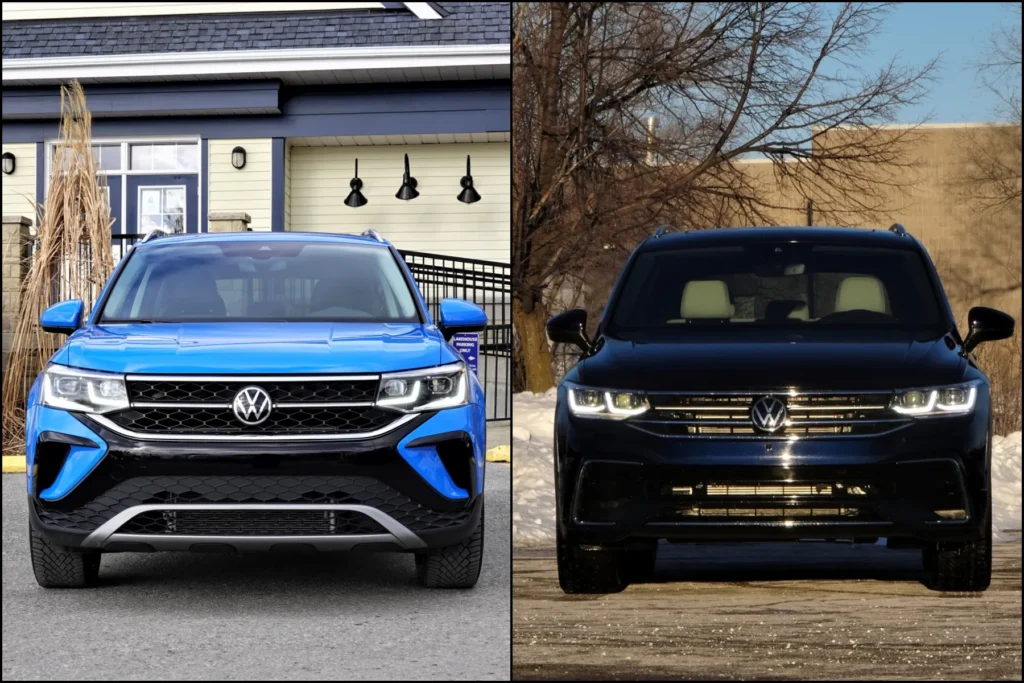
The compact SUV market in Canada continues to grow rapidly, with buyers seeking vehicles that balance size, technology, efficiency, and versatility. Volkswagen’s lineup in this segment features two important contenders: the Volkswagen Taos and the Volkswagen Tiguan. Although both share Volkswagen’s design philosophy and many features, they are built to serve different buyer needs and preferences.
Limited Time Automotive Amazon DealsThis article delivers an in-depth comparison of these two models in the Canadian context, covering everything from pricing, engine options, dimensions, interior features, and safety to ownership considerations.
Market Positioning and Overview
The Volkswagen Taos is positioned as a subcompact SUV designed for urban Canadians looking for affordable practicality, efficiency, and modern features. It competes with rivals like the Honda HR-V and Mazda CX-30.
Limited Time Automotive Amazon DealsOn the other hand, the Volkswagen Tiguan is a compact SUV with more power, space, and premium features, competing with the Toyota RAV4, Ford Escape, and Honda CR-V. It is often chosen by families who need extra room and versatility.
| Specification | Volkswagen Taos | Volkswagen Tiguan |
|---|---|---|
| Vehicle Class | Subcompact SUV | Compact SUV |
| Seating Capacity | 5 | 5 (optional 7) |
| Starting Price (CAD) | ~$31,000 | ~$38,000 |
| Engine Options | 1.5L Turbo Inline-4 | 2.0L Turbo Inline-4 |
| Drivetrain | FWD Standard, AWD Optional | FWD Standard, AWD Optional |
| Cargo Volume (max) | 1,072 L (37.8 cu ft) | 1,830 L (64.6 cu ft) |
Pricing and Trim Levels in Canada
Price is often a key factor for Canadian consumers, especially as new vehicle prices have been climbing.
| Trim Level | Taos Price (CAD) | Tiguan Price (CAD) |
|---|---|---|
| Base | $31,000 | $38,000 |
| Mid | $34,000 | $42,000 |
| High | $38,000 | $48,000 |
| Top Performance Trim | N/A | $53,000 (R-Line/SEL) |
The Taos offers a budget-friendly entry into the VW SUV lineup, with most features Canadian drivers expect. The Tiguan demands a higher investment but delivers more power, space, and premium appointments.
Engine and Performance
Volkswagen Taos
Powered by a 1.5-litre turbocharged inline-4 engine producing 158 horsepower and 184 lb-ft of torque, the Taos is tuned for efficiency and daily usability. An 8-speed automatic transmission is standard, and front-wheel drive comes standard, with Volkswagen’s 4MOTION AWD available as an option.
- Fuel Economy: Approx. 8.5 L/100 km combined, making it one of the more fuel-efficient vehicles in its class.
- Drive: Agile and light, the Taos performs well in urban settings, Canadian highways, and even snowy conditions when equipped with AWD.
Volkswagen Tiguan
The Tiguan steps up with a 2.0-litre turbocharged inline-4 engine that delivers 184 horsepower and 221 lb-ft of torque. This power boost supports better highway passing, towing (up to 1,500 kg), and a more confident driving experience in varied terrain.
- Fuel Economy: Slightly less efficient, averaging about 9.7 L/100 km combined.
- Drive: AWD is more common on the Tiguan trims, providing extra safety and traction during Canadian winters.
| Specification | Volkswagen Taos | Volkswagen Tiguan |
|---|---|---|
| Engine | 1.5L Turbo Inline-4 | 2.0L Turbo Inline-4 |
| Horsepower | 158 hp | 184 hp |
| Torque | 184 lb-ft | 221 lb-ft |
| Transmission | 8-speed automatic | 8-speed automatic |
| Drivetrain | FWD/AWD | FWD/AWD |
| Fuel Economy (Combined) | 8.5 L/100 km | 9.7 L/100 km |
Dimensions and Interior Space
Size differences between the two are subtle but significant for buyers.
| Dimension | Volkswagen Taos | Volkswagen Tiguan |
|---|---|---|
| Length | 4,456 mm (175.4 in) | 4,486 mm (176.5 in) |
| Width | 1,841 mm (72.5 in) | 1,839 mm (72.4 in) |
| Height | 1,603 mm (63.1 in) | 1,676 mm (66.0 in) |
| Wheelbase | 2,680 mm (105.5 in) | 2,681 mm (105.5 in) |
| Passenger Capacity | 5 | 5 (7 optional) |
| Cargo Volume (rear seats up) | 766 L (27 cu ft) | 710 L (25 cu ft) |
| Cargo Volume (rear seats folded) | 1,072 L (37.8 cu ft) | 1,830 L (64.6 cu ft) |
While the Taos offers slightly more cargo space behind the rear seats, the Tiguan shines with overall interior volume and the option of a third row, which can be important for larger families or those needing extra passenger capacity.
Interior Features and Technology
Volkswagen outfits both SUVs with modern infotainment and comfort features, but there are notable differences:
| Feature | Volkswagen Taos | Volkswagen Tiguan |
|---|---|---|
| Infotainment Screen | 6.5” Standard / 8” Optional | 8” Standard / 10.25” Optional |
| Digital Cockpit (Virtual Cluster) | Available on higher trims | Standard on most trims |
| Apple CarPlay / Android Auto | Standard | Standard |
| Climate Control | Manual / Dual-zone Automatic | Dual-zone Automatic |
| Seating | Cloth standard, Leatherette optional | Leatherette standard, Leather optional |
| USB Ports | 2 standard | 3 standard |
| Ambient Lighting | Optional | Standard on higher trims |
The Tiguan generally has a more upscale interior, with higher-grade materials and more advanced technology available, especially in upper trims.
Safety Features and Driver Assistance
Safety is a priority for VW in both models, important for Canadian roads and harsh weather:
| Safety Feature | Volkswagen Taos | Volkswagen Tiguan |
|---|---|---|
| Adaptive Cruise Control | Available | Standard/Available |
| Lane Keeping Assist | Available | Standard |
| Blind Spot Monitoring | Available | Standard |
| Rear Cross Traffic Alert | Standard | Standard |
| Forward Collision Warning | Standard | Standard |
| Automatic Emergency Braking | Standard | Standard |
Both SUVs come well equipped with active and passive safety features, but the Tiguan often includes more advanced driver-assist features as standard at lower trims.
Driving Dynamics and Ride Quality
- Volkswagen Taos: Known for its light and nimble handling, the Taos is ideal for city dwellers and weekend adventurers. It feels responsive in tight spaces and offers a composed ride over Canadian roads. AWD improves winter performance but adds cost.
- Volkswagen Tiguan: Offers a more planted and refined ride, especially at highway speeds. The suspension is tuned for comfort, and the additional torque makes it better suited for towing and longer trips. AWD versions handle Canadian winters very well.
Cost of Ownership and Practicality
Owning an SUV in Canada involves more than just the purchase price. Fuel costs, maintenance, insurance, and resale value are key.
| Ownership Factor | Volkswagen Taos | Volkswagen Tiguan |
|---|---|---|
| Fuel Efficiency | Better fuel economy (approx. 8.5 L/100 km) | Higher fuel consumption (approx. 9.7 L/100 km) |
| Maintenance Costs | Generally lower due to simpler engine | Slightly higher due to larger engine and premium parts |
| Insurance Premium | Lower due to smaller size and cost | Higher due to vehicle value and size |
| Resale Value | Good for subcompact segment | Strong resale in compact SUV segment |
| Winter Capability | AWD option recommended | AWD common and highly effective |
Which One Should Canadian Buyers Choose?
Choose Volkswagen Taos if:
- You prioritize fuel economy and affordability.
- You mostly drive in urban and suburban environments.
- You want a nimble SUV with modern tech and sufficient cargo space for everyday needs.
- Your family size is small (up to 5 passengers) and you rarely need extra cargo volume.
Choose Volkswagen Tiguan if:
- You need more passenger and cargo space, especially with the 7-passenger option.
- You want stronger performance for highway driving and towing.
- You prefer more premium features and a refined interior.
- You live in regions with harsh winters and want a robust AWD system.
Final Thoughts
Both the Volkswagen Taos and Volkswagen Tiguan represent strong choices in Canada’s growing SUV market. The Taos offers excellent value and efficiency, while the Tiguan caters to buyers seeking more space, power, and luxury.
By carefully evaluating your budget, space needs, and driving habits, you can confidently choose the model that best fits your lifestyle in Canada’s diverse and often challenging driving conditions.