Key Points
- G2 License: An intermediate stage in Ontario’s graduated licensing system, allowing independent driving with restrictions like passenger limits for drivers under 19 and a zero blood alcohol concentration (BAC) requirement for those under 22.
- G License: The full, unrestricted driver’s license, obtained after holding a G2 for at least 12 months and passing a more advanced road test that includes highway driving.
- Road Tests: The G2 test focuses on basic city driving skills, while the G test assesses advanced skills, including expressway navigation.
- Insurance Implications: G2 drivers typically face higher insurance premiums due to their limited experience, while G drivers often benefit from lower rates.
- Preparation is Key: Understanding the differences and practicing specific skills can significantly improve your chances of passing both tests.
Understanding G2 and G Licenses
In Ontario, the graduated licensing system is designed to help new drivers gain experience gradually. The G2 license is the second stage, allowing you to drive without supervision but with certain restrictions to ensure safety. The G license, the final stage, grants full driving privileges with no restrictions, provided you pass a more comprehensive road test. This system, in place since 1994, aims to reduce accidents among new drivers by providing a structured learning environment.
Common Questions Overview
New drivers often have questions about the differences between G2 and G licenses, including restrictions, test requirements, and insurance implications. Below, we address these questions in a clear and concise manner to help you navigate the process.
Why It Matters
Understanding the distinctions between G2 and G licenses is crucial for new drivers to comply with legal requirements and prepare effectively for road tests. The graduated system ensures you build skills progressively, making you a safer driver by the time you earn your full G license.
G2 vs G License in Ontario: A Comprehensive Guide to Common Questions
Introduction
Ontario’s graduated licensing system is a structured approach to help new drivers develop the skills and experience needed to drive safely. The system consists of three stages: G1 (learner’s permit), G2 (intermediate license), and G (full license). The G2 and G licenses are critical milestones, but they come with different privileges, restrictions, and requirements. This blog addresses the most common questions about G2 vs G licenses, providing detailed insights to help you navigate the process, prepare for road tests, and understand the implications for insurance and driving privileges. Whether you’re a new driver or a parent guiding a teen through the process, this guide will clarify what you need to know.
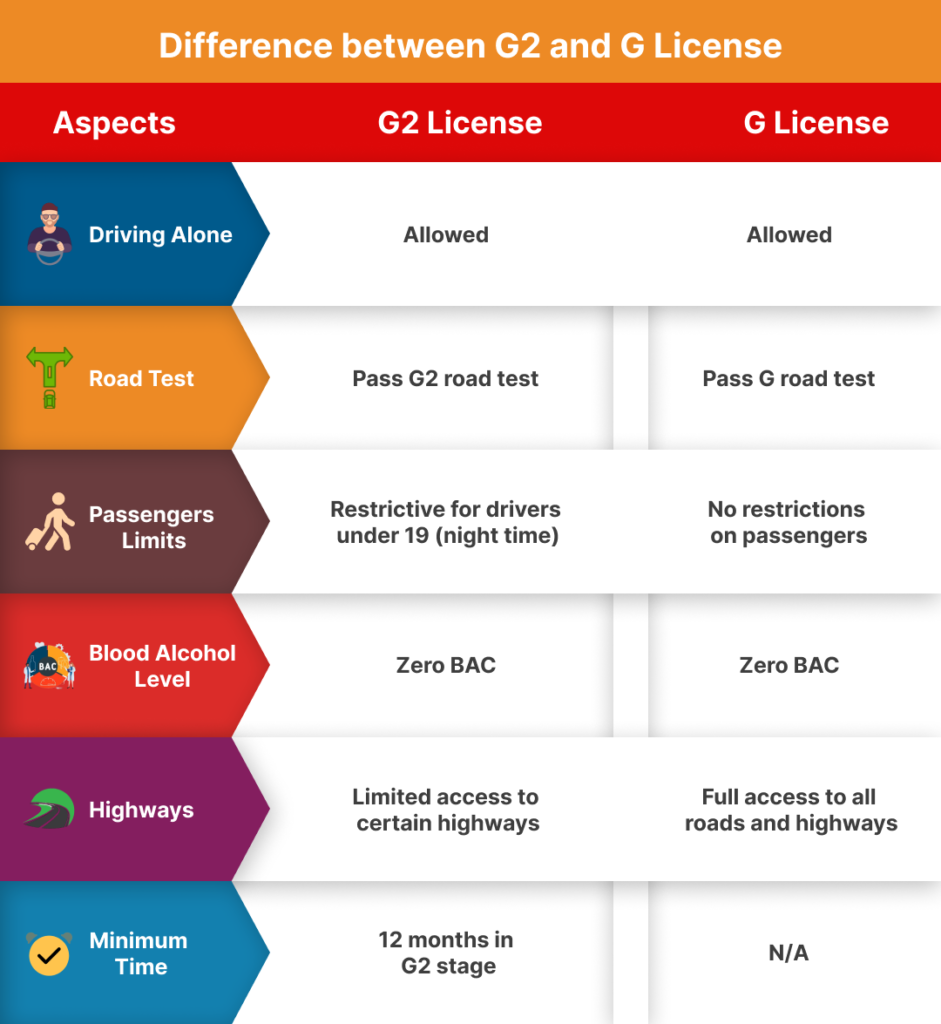
1. What Are the Main Differences Between G2 and G Licenses?
The G2 and G licenses represent distinct stages in Ontario’s graduated licensing system, each with specific privileges and restrictions.
| Aspect | G2 License | G License |
|---|---|---|
| Driving Privileges | Independent driving with restrictions on passengers and BAC. | Unrestricted driving on all roads, including highways. |
| Passenger Restrictions | Under 19: Limited to 1 passenger under 19 (midnight to 5 a.m.) for first 6 months; up to 3 after 6 months. | No passenger restrictions. |
| BAC Requirement | Zero BAC for drivers under 22; 0.05% for those 22+. | General drinking and driving laws apply (0.08% legal limit). |
| Highway Driving | Advised to avoid high-speed highways like the 400 series. | Full access to all highways. |
| Test Requirements | Basic city driving test (20 minutes). | Advanced test including highway driving (30-40 minutes). |
- G2 License: This intermediate stage allows you to drive without a fully licensed driver but imposes restrictions to promote safe driving habits. It’s designed to give you real-world experience while limiting risks.
- G License: The full G license signifies that you’ve demonstrated the skills and experience needed to drive in all conditions without restrictions. It’s the final step to becoming a fully licensed driver.
2. What Restrictions Apply to G2 Drivers?
G2 drivers face several restrictions to ensure they continue to develop safe driving habits:
- Passenger Restrictions (for drivers under 19):
- For the first six months, you can only have one passenger under 19 between midnight and 5 a.m. (unless they’re immediate family members).
- After six months, this limit increases to three passengers under 19 during those hours.
- Blood Alcohol Concentration (BAC):
- Drivers under 22 must maintain a zero BAC while driving.
- For those 22 and older, the BAC limit is 0.05%, but it’s recommended to avoid any alcohol consumption before driving.
- Highway Driving:
- While not strictly prohibited, G2 drivers are encouraged to avoid high-speed highways like the 400 series until they gain more experience or obtain their G license.
These restrictions are enforced to reduce distractions and risks for new drivers, who are statistically more likely to be involved in accidents.
3. What Does the G2 Road Test Involve?
The G2 road test, also known as the G1 exit test, evaluates your ability to handle basic driving tasks in a city environment. It’s the first major road test after holding your G1 license for at least 12 months (or 8 months with a recognized driving school course).
- Test Duration: Approximately 20 minutes.
- Key Components:
- Left and right turns
- Three-point turn
- Parallel parking
- Backing up
- Navigating traffic lights and signs
- Lane changes
- In some locations, expressway driving may be included
- Passing Criteria: You must demonstrate safe driving practices, follow traffic laws, and handle the vehicle confidently. The examiner will assess your ability to check mirrors, signal properly, and respond to traffic situations.
Tips for Success:
- Practice parallel parking and three-point turns in various settings.
- Ensure you check mirrors and blind spots consistently.
- Familiarize yourself with the test route at your local DriveTest centre.
4. What Does the G Road Test Involve?
The G road test is the final step to obtaining your full driver’s license. It’s more comprehensive than the G2 test, focusing on advanced driving skills, particularly on highways.
- Test Duration: Approximately 30-40 minutes.
- Key Components:
- All G2 test elements (turns, parking, etc.)
- Expressway driving, including:
- Merging onto highways
- Changing lanes at highway speeds
- Exiting highways
- Handling complex intersections and traffic scenarios
- Passing Criteria: The examiner will evaluate your ability to manage higher speeds, make safe decisions in complex situations, and maintain control of the vehicle.
Tips for Success:
- Practice highway driving, focusing on smooth merging and lane changes.
- Book your test during off-peak hours to avoid heavy traffic.
- Review the Ontario Driver’s Handbook for highway-specific rules.
5. How Long Do I Need to Hold a G2 Before Applying for a G License?
You must hold your G2 license for at least 12 months before you can take the G road test. This mandatory waiting period ensures you gain sufficient driving experience in various conditions, preparing you for the challenges of the G test. If you’ve completed a Ministry of Transportation (MTO)-approved driving school course, this period remains the same for the G test, though it can reduce the G1 waiting period.
6. Are There Insurance Implications for G2 vs G Drivers?
Insurance premiums and coverage can vary significantly between G2 and G drivers:
- G2 Drivers:
- Considered higher risk due to limited experience, leading to higher insurance premiums.
- May need to be added as a primary or secondary driver on a household policy if they don’t own a vehicle (TD Insurance).
- Some insurers offer discounts for completing a recognized driving course.
- G Drivers:
- Generally benefit from lower premiums due to their experience and unrestricted status.
- May qualify for additional discounts as fully licensed drivers.
It’s advisable to compare quotes from multiple insurers when transitioning from G2 to G to secure the best rates.
7. What Are the Eligibility Criteria for Each Test?
- G2 Road Test:
- Must have held a G1 license for at least 12 months (or 8 months with a recognized driving school course).
- Must be at least 16 years old.
- Must pass a vision test and pay the test fee ($53.75 if retaking; included in the G1 package initially).
- G Road Test:
- Must have held a G2 license for at least 12 months.
- No specific age requirement beyond meeting the G2 holding period.
- Must pay the test fee ($91.25) and a licensing fee ($90) upon passing.
Benefits of Ontario’s Graduated Licensing System
Introduced in 1994, Ontario’s graduated licensing system has significantly reduced accidents among young drivers. According to the Ministry of Transportation, collision rates for 16-19-year-old drivers dropped by 35% between 1994 and 2004. The system’s structured approach allows new drivers to:
- Practice with supervision during the G1 stage.
- Gain independent driving experience with restrictions during the G2 stage.
- Achieve full privileges with the G license after demonstrating advanced skills.
This gradual progression creates a safer learning environment, reducing the risk of accidents and fatalities.
Common Mistakes to Avoid During Road Tests
Avoiding common errors can make the difference between passing and failing your road test:
- G2 Test:
- Failing to check mirrors and blind spots before lane changes or turns.
- Not signaling properly or at all.
- Incomplete stops at stop signs or traffic lights.
- Poor parallel parking (e.g., hitting the curb or misaligning).
- G Test:
- All G2 mistakes, plus:
- Unsafe highway merging (e.g., not yielding to traffic).
- Incorrect speed management on expressways (too slow or too fast).
- Failure to navigate complex intersections correctly.
Preparation Tips:
- Practice with a licensed driver or instructor to refine your skills.
- Use resources like the DriveTest website to understand test expectations.
- Take a few lessons at a driving school like Gold Star Driving School for targeted training.
Conclusion
Navigating the G2 and G license stages in Ontario can seem daunting, but understanding the differences, restrictions, and test requirements can make the process smoother. The G2 license offers a critical period to build confidence and skills, while the G license grants full freedom to drive in any condition. By preparing thoroughly, practicing key maneuvers, and staying informed about the rules, you can successfully progress through Ontario’s graduated licensing system. Whether you’re gearing up for your G2 test or aiming for your full G license, patience and practice are your best allies on the road to becoming a safe and confident driver.