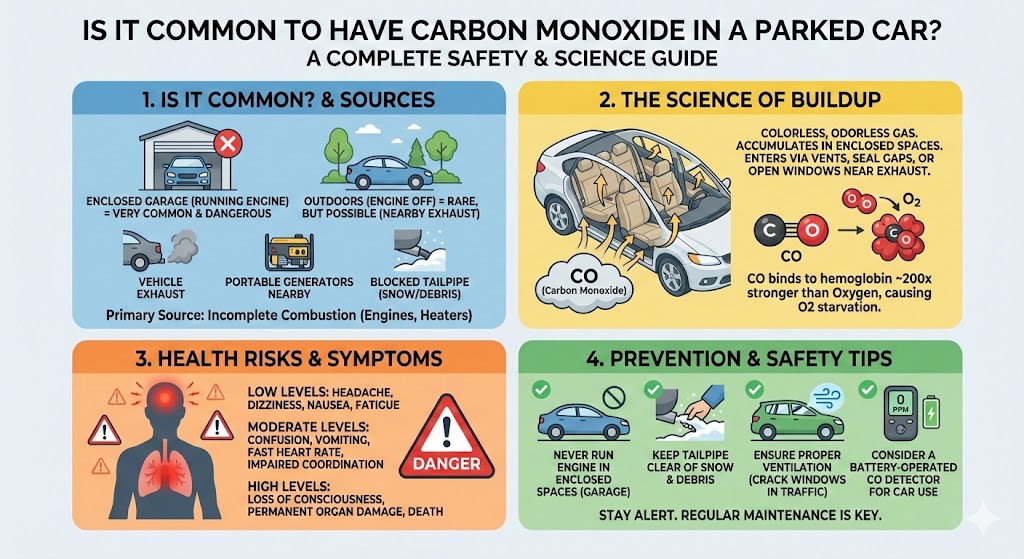
Carbon monoxide poisoning remains one of the most underestimated dangers linked to automobiles. Despite decades of public warnings, thousands of hospitalizations and hundreds of deaths still occur every year due to vehicle-related carbon monoxide exposure. One question is asked more than any other:
Is it common to have carbon monoxide inside a parked car?
The short answer is:
It depends entirely on whether combustion is occurring and how well ventilated the environment is.
The long answer is far more technical, nuanced, and critical for everyday safety — and that’s what this guide covers in full.
This article breaks down:
- How carbon monoxide behaves inside and around parked vehicles
- When exposure is likely and when it is not
- Why certain conditions are especially dangerous
- The medical effects of carbon monoxide
- High-risk real-world scenarios
- The role of modern vehicles including hybrids and remote start systems
- How to fully eliminate the risk
What Exactly Is Carbon Monoxide?
Carbon monoxide (CO) is a toxic gas produced during incomplete combustion of fuel. Any time gasoline, diesel, propane, natural gas, or wood burns without perfect oxygen balance, carbon monoxide is created.
Key properties of CO:
- Colorless
- Odorless
- Non-irritating
- Lethal at very low concentrations
This combination makes it uniquely dangerous — humans cannot naturally detect it without a sensor.
How Do Cars Produce Carbon Monoxide?
Every internal combustion vehicle produces carbon monoxide as a byproduct of burning fuel. Sources include:
- Gasoline engines
- Diesel engines
- Hybrid vehicles when their combustion engine is running
- Motorcycles
- Snowmobiles
- Small engines like generators and lawn equipment
In a properly working vehicle, the catalytic converter converts most CO into carbon dioxide before it exits the tailpipe, but no vehicle fully eliminates CO.
Whenever a car’s engine is ON, carbon monoxide is being created.
Can a Parked Car Have Carbon Monoxide If the Engine Is Off?
Technically: No New CO Is Being Produced
If the vehicle engine is completely off, the car itself cannot generate new carbon monoxide because combustion has stopped.
However, this does not guarantee that the inside of the vehicle is free of carbon monoxide.
How Carbon Monoxide Can Enter a Parked Car With the Engine Off
Even when a vehicle is not running, CO can enter from external sources under specific conditions:
1. Nearby Idling Vehicles
If another car is running nearby in:
- A closed garage
- A shared underground driveway
- A tightly enclosed parking structure
CO can migrate through:
- HVAC intake vents
- Door seals
- Trunk gaps
- Undercarriage openings
2. Combustion Equipment Operating Nearby
Common sources:
- Gas heaters
- Snowblowers
- Portable generators
- Gas-powered lawn tools
These release concentrated CO that can infiltrate a parked vehicle within minutes.
3. Building Exhaust Systems
Some buildings vent:
- Furnaces
- Boilers
- Backup power generators
If vented into an enclosed parking structure, CO accumulation becomes possible.
The Highest-Risk Scenario: A Parked Car With the Engine Running
This is the single most dangerous configuration involving a parked vehicle.
A car that is:
- Running
- Stationary
- Enclosed or partially enclosed
is producing carbon monoxide continuously with nowhere for it to escape.
Why Carbon Monoxide Builds Up So Quickly in Parked Vehicles
Several physical factors accelerate CO accumulation:
- Exhaust is concentrated near ground level
- Vehicle cabins are partially sealed
- Garage walls trap airflow
- Cold air slows gas dispersion
- Exhaust recirculation increases during idling
In closed environments, CO concentrations can reach lethal levels within 2–5 minutes.
Real-World Data on Carbon Monoxide Exposure From Vehicles
According to North American public safety data:
- Over 50,000 emergency room visits per year are linked to accidental CO exposure
- Roughly 400 deaths annually occur from unintentional CO poisoning
- A significant percentage involve vehicles in garages or near buildings
- Children and older adults are most vulnerable
Winter months account for the highest number of vehicle-related exposures.
The Snow Blockage Danger Most Drivers Don’t Think About
One of the most overlooked hazards is snow obstructing the tailpipe.
During heavy snowfall:
- Exhaust gases recirculate under the vehicle
- CO enters through floor and trunk seals
- Cabin CO levels rise without obvious warning
This has caused fatal poisonings even in parked vehicles outdoors.
Exhaust System Leaks: A Silent Entry Point
A damaged exhaust system caused by:
- Rust
- Corrosion
- Broken flex pipes
- Poor repairs
can allow carbon monoxide to leak directly beneath the passenger compartment. When idling, this turns the cabin into a low-level gas chamber.
Remote Start Systems and Carbon Monoxide Risk
Modern vehicles frequently include remote start systems. These increase CO risk in two ways:
- Owners forget the vehicle has been started inside a garage
- Timers reset and restart combustion unexpectedly
Remote start has become a major contributing factor in winter CO accidents.
What About Hybrids and EVs?
Hybrid Vehicles
Hybrids only produce CO when the gasoline engine engages. This can happen:
- Automatically
- Unexpectedly
- During cabin heating
People often assume hybrids are “safe” indoors. This is incorrect.
Electric Vehicles (EVs)
EVs do not produce carbon monoxide at all. However:
- They can still accumulate CO if parked near combustion sources
- EV garages can still become contaminated by other vehicles
Medical Effects of Carbon Monoxide on the Human Body
CO binds to hemoglobin over 240 times more strongly than oxygen. This prevents oxygen delivery to the brain and organs.
Low Exposure (10–30 ppm):
- Mild headache
- Fatigue
- Light dizziness
Moderate Exposure (30–150 ppm):
- Severe headache
- Nausea
- Visual disturbances
- Impaired decision making
High Exposure (150+ ppm):
- Confusion
- Vomiting
- Collapse
- Seizures
- Loss of consciousness
- Death
Children and pets are affected faster due to smaller lung capacity.
Can CO Linger in a Parked Car After the Engine Is Off?
Yes. Depending on:
- Cabin size
- Temperature
- Vent positions
- Whether doors were opened
CO can remain trapped inside the cabin for:
- Several minutes
- Occasionally longer in cold environments
Opening all doors and allowing forced ventilation resolves this quickly.
Is It Safe to Sit in a Parked Car With the Engine Running?
Only in fully open outdoor spaces, and even then:
- Wind direction matters
- Snow obstruction matters
- Exhaust leaks still matter
It is never safe to run a vehicle in:
- Garages
- Storage units
- Underground parking stalls
Is Sleeping in a Parked Car Dangerous?
Yes — this is one of the most common fatal use cases.
Even if the engine is initially off:
- Someone may start a nearby car
- Exhaust may infiltrate
- The sleeper cannot detect CO buildup
Sleeping in a running car remains an extremely high-risk behavior.
How Common Is Carbon Monoxide in Parked Cars Overall?
Outdoors + Engine Off
Not common.
Outdoors + Engine On
Possible but uncommon unless exhaust is blocked.
Enclosed Space + Engine Off
Possible via external sources.
Enclosed Space + Engine On
Extremely common and extremely dangerous.
Signs a Parked Car May Have Carbon Monoxide Inside
Because CO is undetectable naturally, warning signs relate to symptoms only:
- Headache
- Dizziness
- Nausea
- Sudden fatigue
- Confusion
If symptoms occur:
- Exit immediately
- Get fresh air
- Call emergency services if symptoms persist
How Carbon Monoxide Detectors Save Lives
Portable CO detectors cost very little and can:
- Alert drivers in garages
- Prevent overnight exposure
- Detect exhaust leaks
They are one of the most effective risk prevention tools available.
How to Completely Prevent Carbon Monoxide Risk Around Vehicles
Always:
- Turn off the engine before entering enclosed spaces
- Clear snow around the exhaust pipe
- Maintain exhaust system integrity
- Use CO detectors in garages
- Ventilate enclosed spaces regularly
Never:
- Idle in garages
- Use remote start indoors
- Sleep in a running vehicle
- Use generators near vehicles
- Assume hybrid vehicles are CO-safe indoors
Why Carbon Monoxide Accidents Continue to Happen Despite Warnings
The main causes:
- Overconfidence
- Misunderstanding ventilation
- New technologies (remote start, hybrids)
- Poor winter exhaust awareness
- Lack of CO detection equipment
Human behavior is responsible for nearly all cases.
Legal & Liability Implications of CO Exposure
Carbon monoxide exposure can create:
- Wrongful death lawsuits
- Product liability claims
- Property owner negligence cases
- Employer safety violations
Many cases involve garages, rental properties, and shared underground parking.
Final Answer: Is Carbon Monoxide in a Parked Car Common?
Here is the definitive conclusion:
- Outdoors + Engine Off → Rare
- Outdoors + Exhaust Blocked → Dangerous
- Enclosed Space + Engine Off → Possible
- Enclosed Space + Engine Running → Extremely Common and Extremely Deadly
Carbon monoxide inside parked vehicles is not random — it is the direct result of combustion + insufficient ventilation.
Final Safety Takeaway
Carbon monoxide exposure from parked vehicles is entirely preventable. Every serious incident can be traced back to one failure:
- Running combustion where air cannot circulate
Understanding this principle eliminates nearly all risk.